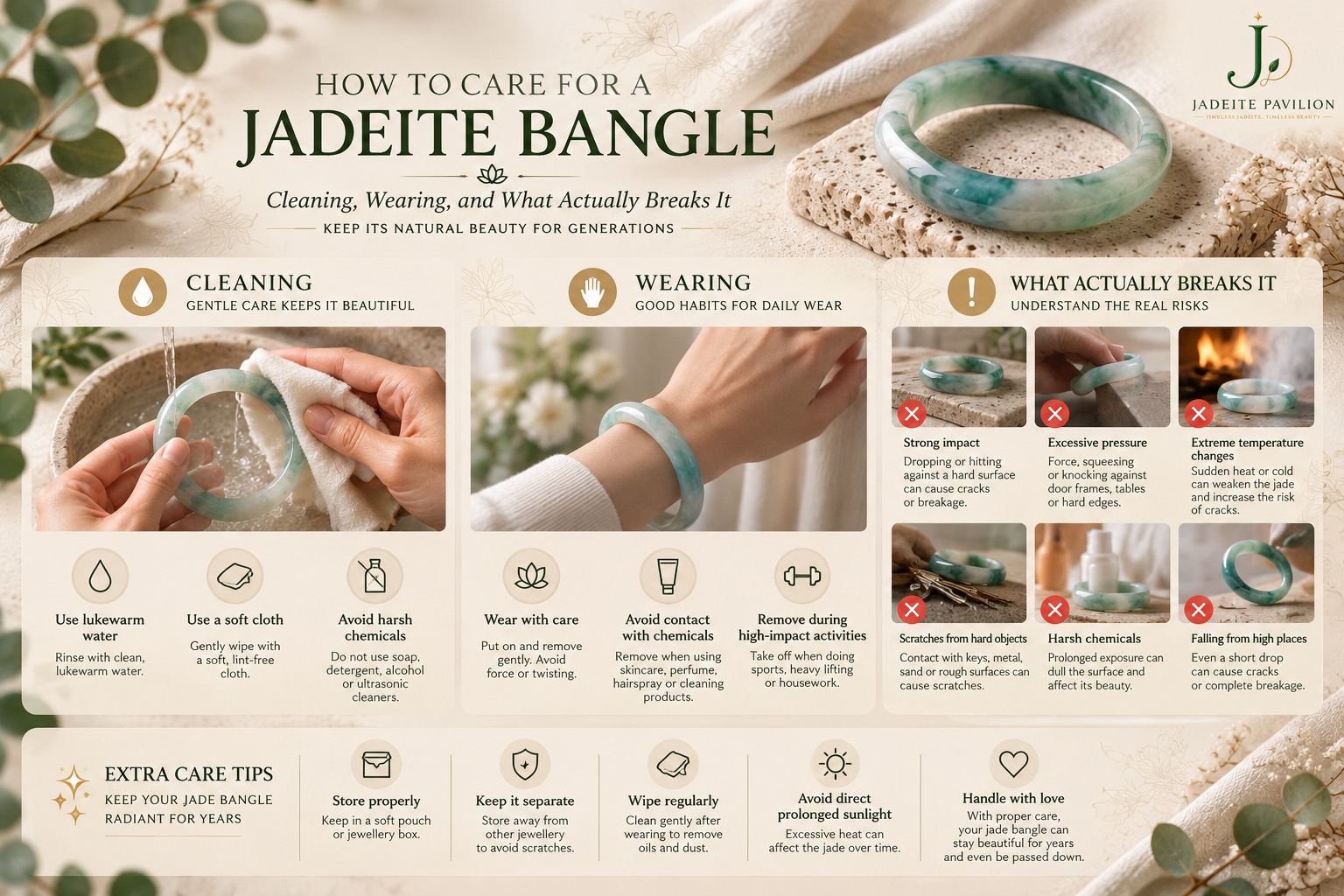
The short answer
Wash a jade bangle in warm water with a drop of mild soap, rub the inside where skin oils collect, rinse, and pat it dry. Nothing else is needed and almost nothing else is safe. Jadeite is not porous, so water will not harm it. What harms it is a hard floor.
Everything below is the long version: what your bangle can genuinely survive, the one habit that causes most breakages, and what to do when it will not come off your hand.
How to clean a jade bangle
The surface that needs cleaning is the one you cannot see. Skin oils, hand cream, and soap film build up on the inside of the bangle and slowly take the shine off the polish. A piece that looks dull is usually not damaged, just coated.
- Fill a bowl with warm, not hot, water and add one drop of mild dish soap.
- Let the bangle sit for a minute, then rub the inside with your fingers or a soft toothbrush.
- Rinse in clean warm water so no soap film is left behind, working over a towel or a bowl rather than an open sink.
- Pat dry with a soft microfibre cloth. Paper towel and tissue can leave fine scratches on a high polish.
Once or twice a month is plenty for a piece worn daily. Jadeite that is worn constantly often needs cleaning less than jewellery kept in a drawer, because it is never sitting in dust.
What to keep away from it
Grade A jadeite is natural and untreated, so there is no dye or polymer in it to strip out. The risk is to the polish and, on set pieces, to the metal and the glue.
| Avoid | Why |
|---|---|
| Ultrasonic and steam cleaners | Vibration and hot steam can loosen a setting or a bail, and can worsen a stone line that was already there. |
| Bleach, ammonia, acetone, drain cleaner | Harsh chemicals attack the polish and any metal the stone is set into. Remove your piece before cleaning the house. |
| Toothpaste and scouring cream | They are abrasives. They will take the mirror finish off a polished stone in a few minutes. |
| Saunas, hot tubs, and sudden temperature swings | Stone does not enjoy going from very hot to very cold. Heat also softens the adhesive on glued bails. |
| Perfume, hairspray, and lotion, applied over the piece | They leave a film that dulls the surface. Put jadeite on last when you dress, and take it off first. |
Can a jade bangle get wet?
Yes. Natural jadeite is a dense, non-porous stone. Washing your hands with it on, being caught in the rain, or rinsing it under the tap does nothing to it. There is no need to take a bangle off every time you reach a sink, and taking it off constantly is itself a risk, because that is when it gets dropped.
Long soaks are a different matter. Chlorinated pools, hot tubs, and sea water are worth avoiding, partly for the chemistry and partly because cold water shrinks your hand and a bangle can slide straight off in a pool without you noticing.
Can you wear it every day, and sleep in it?
Yes, and most owners do. A bangle that is worn continuously tends to look better than one that is worn occasionally, because contact with skin keeps it clean and slowly burnishes the surface. Sleeping in a bangle is common and harmless, though a very slim or a very wide piece can be uncomfortable against a mattress at first.
Take it off for sport, for gardening, for lifting anything heavy, and for work with your hands. Those are the moments when a wrist meets a doorframe or a concrete step at speed.
What actually breaks a jade bangle
Jadeite is one of the toughest materials you can wear. Hardness and toughness are not the same thing: hardness is resistance to scratching, and toughness is resistance to breaking. Jadeite is made of tightly interlocking crystals with no easy plane to split along, which is why it survives daily knocks that would chip many showier gemstones.
None of that helps against a tiled floor. Nearly every broken bangle in the world broke the same way, and it is not a dramatic accident. Someone took it off over a bathroom sink, or pulled it off while undressing, and it landed on porcelain, tile, granite, or stone.
So the single most useful habit in this whole guide is this: put a bangle on and take it off over a bed, a carpet, or a folded towel. Never over a sink, and never standing on a hard floor. That one change prevents more damage than every cleaning rule combined.
- Store each piece separately in the pouch or cloth it arrived in, not loose in a box with harder gemstones.
- When travelling, keep a bangle in hand luggage, wrapped, and ideally inside a rigid case rather than loose.
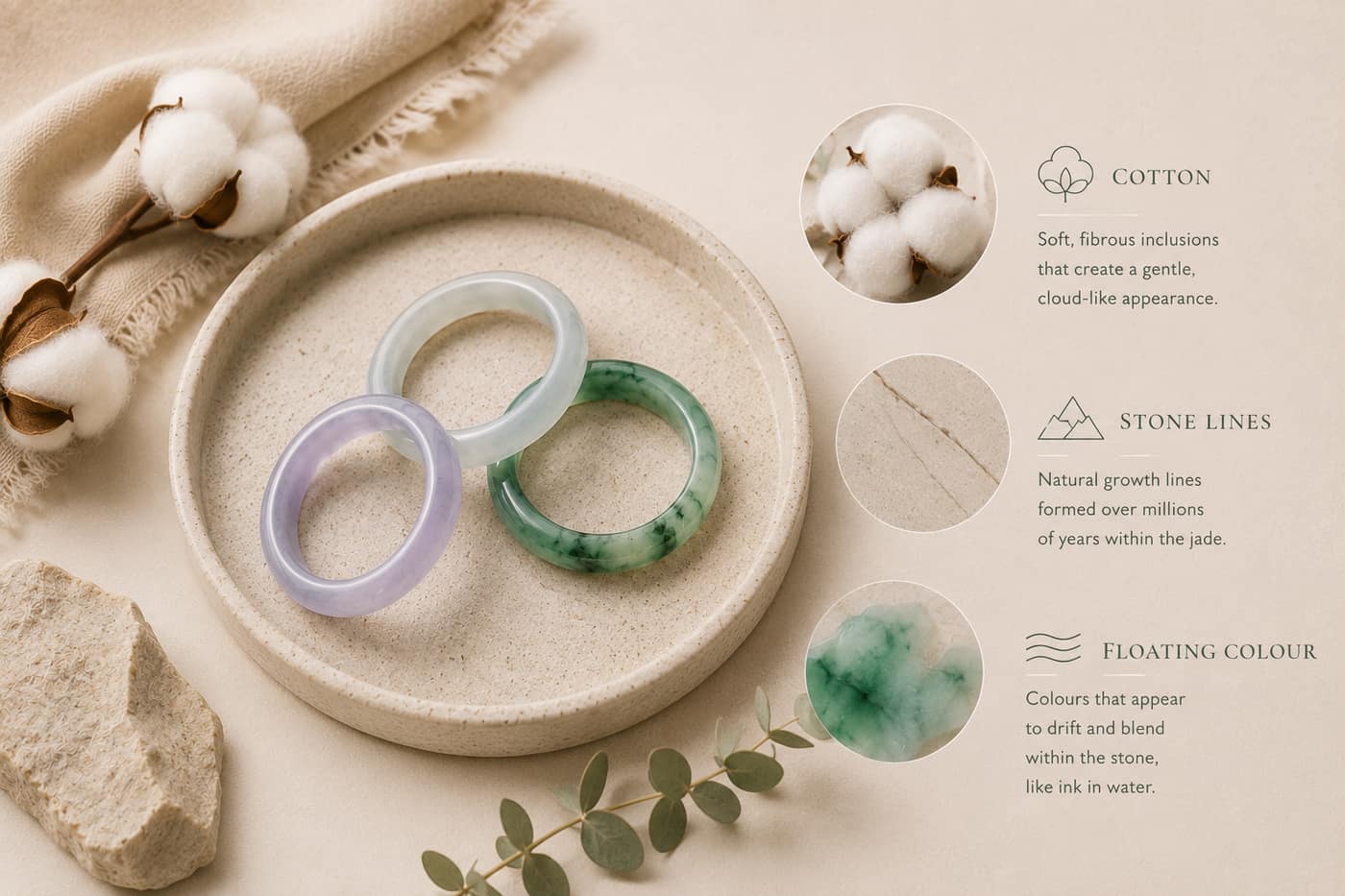
- If a bangle has an existing stone line (石纹), treat it as a piece to be a little gentler with. A healed line is structurally sound, but it is still the place a hard knock would find.
Which wrist should you wear it on?
There is no rule, and anyone who tells you otherwise is repeating a custom as though it were a requirement. Chinese tradition commonly favours the left wrist, and you will hear various explanations for it depending on who is explaining.
The practical answer happens to agree with the traditional one. For most people the left is the non-dominant hand, so a bangle worn there is knocked less, caught on fewer door handles, and rested on fewer desks. If you are left-handed, wear it on the right for exactly the same reason.
How to remove a stuck bangle safely
Hands swell in heat, after salty food, during pregnancy, and simply with age. A bangle that went on easily two years ago can be genuinely difficult to remove, and forcing it is how people hurt themselves.
- Run the hand under cold water, then hold the arm straight up for a minute. Both reduce swelling.
- Work plenty of soap, hand lotion, or cooking oil all around the hand, including the back and the base of the thumb.
- Tuck your thumb into your palm toward the base of the little finger, making the hand as narrow as it goes, then press the bangle over the knuckles and rotate it gently rather than pulling straight.
- A thin plastic bag slipped over the hand under the bangle cuts the friction further, which is the trick jewellers use.
Stop if your hand is painful, swelling further, or changing colour, and get help. A bangle is replaceable and a hand is not. A jeweller can cut a stuck bangle off safely if it comes to that, and the stone can often be remade into a pendant afterwards.
Does jade change colour the longer you wear it?
A well-worn bangle often does look warmer and glossier after a year or two. The honest explanation is ordinary: constant contact with skin polishes the surface and fills microscopic scratches with body oils, so light reflects more evenly and the colour reads deeper. The stone itself has not changed.
It is worth saying plainly that this has nothing to do with the wearer's health or luck, whatever you may have read. What it does confirm is that the piece is untreated. Grade A jadeite has no dye to fade and no polymer to yellow, which is precisely why a natural stone looks better with age while a treated one looks worse. If you want to know how to tell the difference, our guide to Grade A, B and C covers it properly.
If it does break
There is a tradition, widely held and kindly meant, that a bangle breaks because it took a misfortune in your place. We will not tell you what to believe about that. What we will tell you honestly is the mechanism: jade breaks because it struck something harder than itself, and that is the beginning and the end of the physics.
A broken bangle is not necessarily finished. A clean break can be mounted in gold or silver and worn as a cuff, and a badly broken one can be cut down into a pendant, a ring face, or a pair of earrings. Jade has been rescued this way for centuries. Send us a photo if it happens to a piece of ours and we will tell you honestly what is possible.
Care at a glance
- Warm water, mild soap, soft cloth. Nothing stronger.
- Water is fine. Chlorine, saunas, and long soaks are not.
- On last when dressing, off first when undressing.
- Put it on and take it off over something soft, never over a sink.
- Store it wrapped and separate from harder stones.
- Wear it. A jade bangle kept in a drawer is the only kind that never improves.
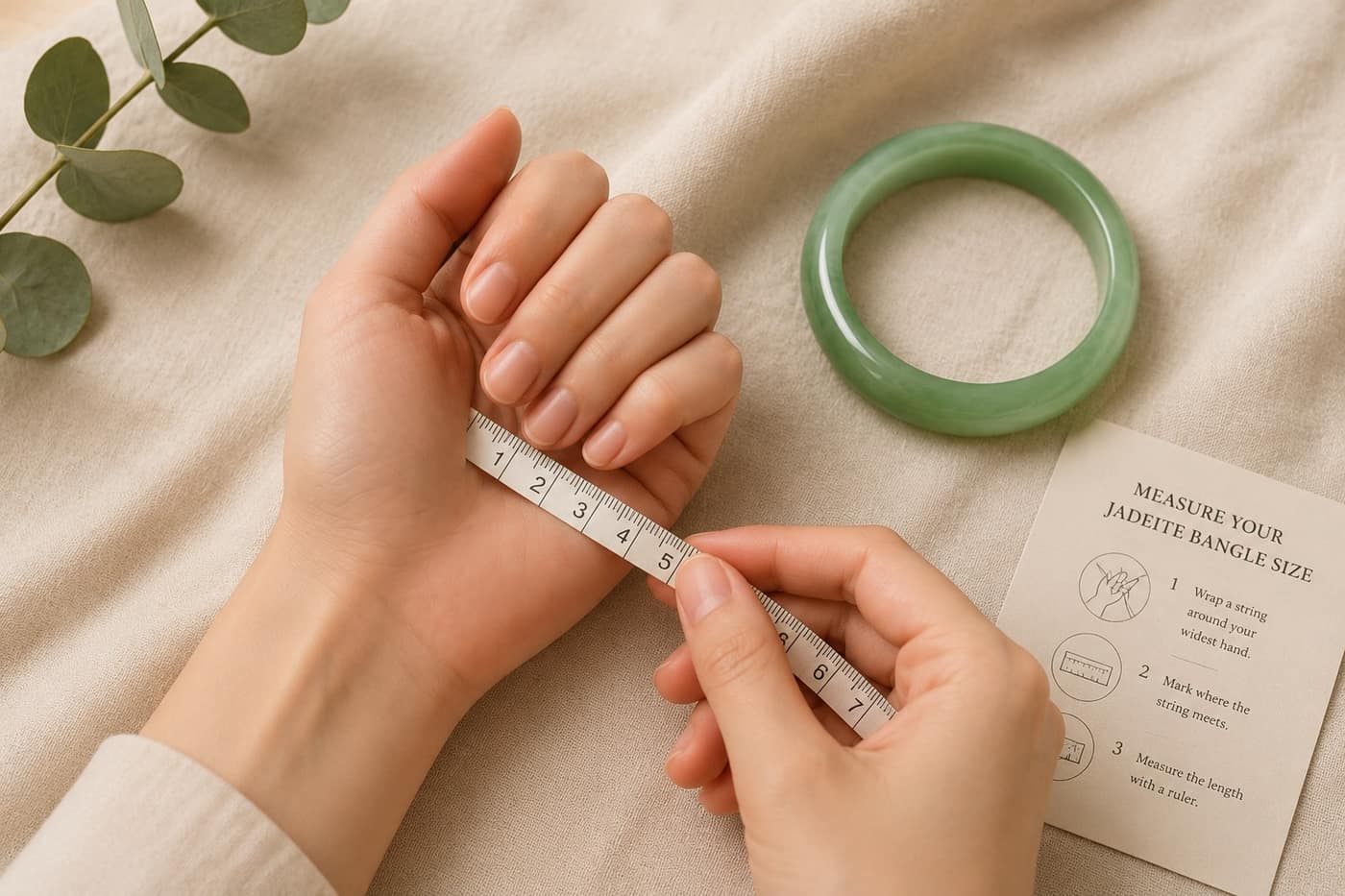
Every piece we sell is natural, untreated Grade A jadeite, and the same care applies to all of it. If you are choosing a first bangle, the sizing guide matters more than anything here, because a bangle that fits properly is a bangle you are not constantly wrestling on and off.