What are the types of jade bangle?
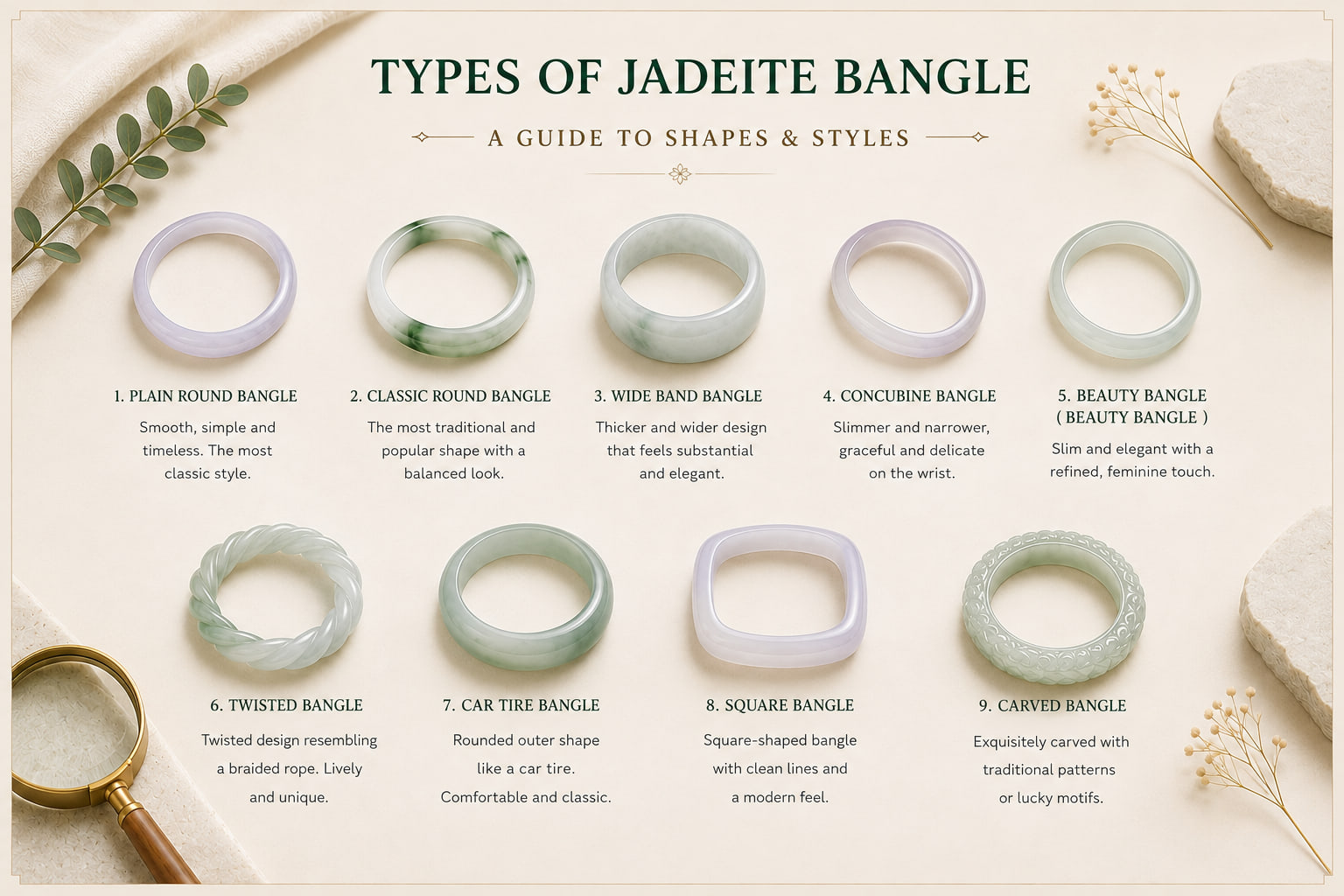
The guide above lays out the nine shapes you are most likely to meet: the plain round and classic round, the broad wide band, the oval concubine bangle, the slender beauty bangle, the twisted bangle, the cushioned car tire bangle, the square bangle, and the carved bangle.
It looks like a lot of names, but almost every one is really answering two questions at once: what shape is the outline (a circle or an oval?) and what shape is the bar (round, flat, or square where it crosses your wrist?). Learn those two questions and the whole vocabulary opens up.
- Round outline, round bar = the plain round, classic round, beauty and car tire bangles. Traditional, and sits high on the wrist.
- Round outline, flat bar = the wide band and the square bangle. Easy to wear, and the shape that shows the most stone.
- Oval outline = the concubine bangle. Follows the real shape of a wrist, slides less, usually the best value.
- Thinner and narrower means cheaper and more fragile; thicker and wider means costlier and sturdier. Carving is a separate question again.
Two questions name every bangle
Seen from above, is the ring a circle or an oval?
Cut the ring across. What shape is the stone where it crosses your wrist?
Jade bangle types compared
The whole vocabulary in one place. Bar measurements are indicative of what is commonly made, not fixed rules, and price is relative to the same stone cut into a different shape.
| Type | Outline | Bar | Typical bar | Relative price | Best for |
|---|---|---|---|---|---|
| Plain round bangle | Round | Round | 8-12 mm round | Moderate | A clean, timeless everyday piece |
| Classic round bangle | Round | Round | 10-14 mm round | Higher | The traditional look; gifts for elders |
| Wide band bangle | Round | Flat, broad | 14-20 mm wide | High | Showing floating colour |
| Concubine bangle | Oval | Flat or softly rounded | 8-11 mm wide | Best value | Slimmer wrists, minimal sliding |
| Beauty bangle | Round | Round, slender | 6-8 mm round | Lower | Stacking; a light, refined line |
| Twisted bangle | Round | Round, twisted | 10-14 mm round | High (labour) | Collectors of carving work |
| Car tire bangle | Round | Rounded outer | 11-15 mm | Moderate | All-day comfort |
| Square bangle | Round | Square | 8-12 mm square | Moderate | Modern looks; even, translucent stone |
| Carved bangle | Any | Any, carved outer face | Varies | Varies | Stone with character rather than clarity |
Why does the same bangle have several different names?
There is no standards body for this. A broad flat band is sold as a "wide band" by one seller and a "board bangle" by another; "princess" and "concubine" usually mean the same oval; and "plain round" and "classic round" are close cousins that different shops draw the line between differently. When in doubt, go by the measurements rather than the label.
One distinction is worth keeping straight. Plain means uncarved, not a particular shape, and round can refer either to the outline or to the bar. So a listing that just says "round" does not tell you the whole story. Ask for the inner diameter together with the bar width and thickness, and the ambiguity disappears.
The types of jade bangle, one by one
These are the shapes you will actually encounter. For each one: what it is, and what living with it is like.
- Plain round bangle
- Also sold as: plain roundA plain round bangle has a round outline and a smooth, uncarved round bar - the simplest and most timeless jade bangle shape. Nothing is carved into it, so the stone shows plainly and its colour and translucency do all the work. It is the shape most people picture when they imagine a jade bangle.In wear: A round bar sits high off the wrist and rolls as you move; it needs about 1-2 mm more clearance than a flat bar.
- Classic round bangle
- Also sold as: classic round, round barA classic round bangle is the traditional round-outline, round-bar bangle - the most established and popular shape, with balanced, generous proportions. It differs from the plain round mainly in feel: a fuller, rounder bar that reads as substantial and formal. This is the classic gift shape.In wear: A full round bar uses the most stone, so it is among the dearest shapes for a given quality, and the heaviest on the wrist.
- Wide band bangle
- Also sold as: wide band, wide flat, board bangleA wide band bangle is a flat bangle made much broader than usual, so it reads as a band and gives a large, uninterrupted view of the stone. The thicker, wider profile feels substantial and elegant, and it is the shape used to show off beautiful floating colour across a big surface.In wear: A wide, clean, evenly coloured face is one of the hardest things in jade to find, so this is an expensive shape - and a heavier one on the wrist.
- Concubine bangle
- Also sold as: oval bangle, princess bangleA concubine bangle is oval rather than circular, named after the Tang dynasty consort Yang Guifei, and follows the natural oval shape of the wrist. Slimmer and narrower on the arm, graceful and delicate. Because a wrist is oval and not round, it sits closer to the arm and slides far less than a circle of the same size.In wear: Quoted as two measurements, for example 56 x 48 mm. The long axis has to clear your hand; the short axis is what stops it sliding. Yields more bangles per block of rough, so it is often the best value.
- Beauty bangle
- Also sold as: slim round, thin bangleA beauty bangle is a small round bangle with a very slender round bar, usually 6-8 mm thick, made to look light and refined on a fine wrist. A Qing court shape with a delicate, feminine touch, and the natural choice if you want to wear two or three bangles together rather than one statement piece.In wear: Less stone means a lower price, but a thin bar chips and snaps far more easily than a thick one. Not the bangle for gardening or gym bags.
- Twisted bangle
- Also sold as: rope bangleA twisted bangle is a round bar carved into a continuous rope twist - a lively, unusual shape that resembles braided rope. It needs a thick bar to start with and a great deal of patient work to finish, so it is uncommon and distinctive.In wear: Priced for the carver hours as much as the stone. The grooves collect lotion and soap, so it wants an occasional soft brush.
- Car tire bangle
- Also sold as: car-tire bangle, rounded flatA car tire bangle has a plump, rounded outer profile like a tyre - comfortable, classic, and smooth against the wrist. The cushioned cross-section has no sharp edges, so it wears comfortably all day while still feeling substantial.In wear: The rounded bar uses more stone than a flat one, sitting between a flat and a full round bar in both feel and price.
- Square bangle
- Also sold as: square bangle, flat-faceA square bangle has flat faces meeting at crisp, defined edges instead of a dome, giving clean lines and a modern feel. It shows the stone as broad flat planes rather than curves, which flatters even, translucent colour and makes the body of the jade easy to read.In wear: Those crisp edges are the vulnerable part - a knock lands on a corner rather than a curve. Best on a stone with good, even body.
- Carved bangle
- Also sold as: engraved bangleA carved bangle is any bangle shape with a design cut into its outer face - bamboo, lotus, dragon and phoenix, or other traditional and lucky motifs. The opposite is a plain bangle left smooth. Carving is sometimes purely decorative, and sometimes a way to cut away a stone line, a crack, or a patch of dead colour.In wear: Both reasons are legitimate, and neither makes a bangle lesser. It simply deserves the question: what was carved away, and why? An honest seller will tell you.
On carved bangles specifically: a design cut into the outer face may be pure decoration, or it may remove a stone line or a patch of dead colour. Both are legitimate. Neither should be a surprise.
Does the shape of a jade bangle affect the price?
Yes. Two bangles cut from the same block of jadeite, with identical colour and translucency, can differ substantially in price purely because of their shape. The reason is simple: how much stone the shape consumes, and how much of the block it wastes.
- Round bars cost more than flat bars. A circular cross-section has to be cut from much thicker rough, and the material hollowed out of the middle is gone.
- Wide bars cost more than narrow ones, and a wide bar that is clean and even across its whole face is rare enough to be priced in a different league.
- Ovals are efficient. A concubine bangle can be planned around the shape of the rough, so more usable bangles come out of the same block. That efficiency reaches you as a lower price.
- Carving is labour, not stone. A finely carved bangle charges for the carver hours. A lightly carved one may simply be a piece where a mark was cut away.
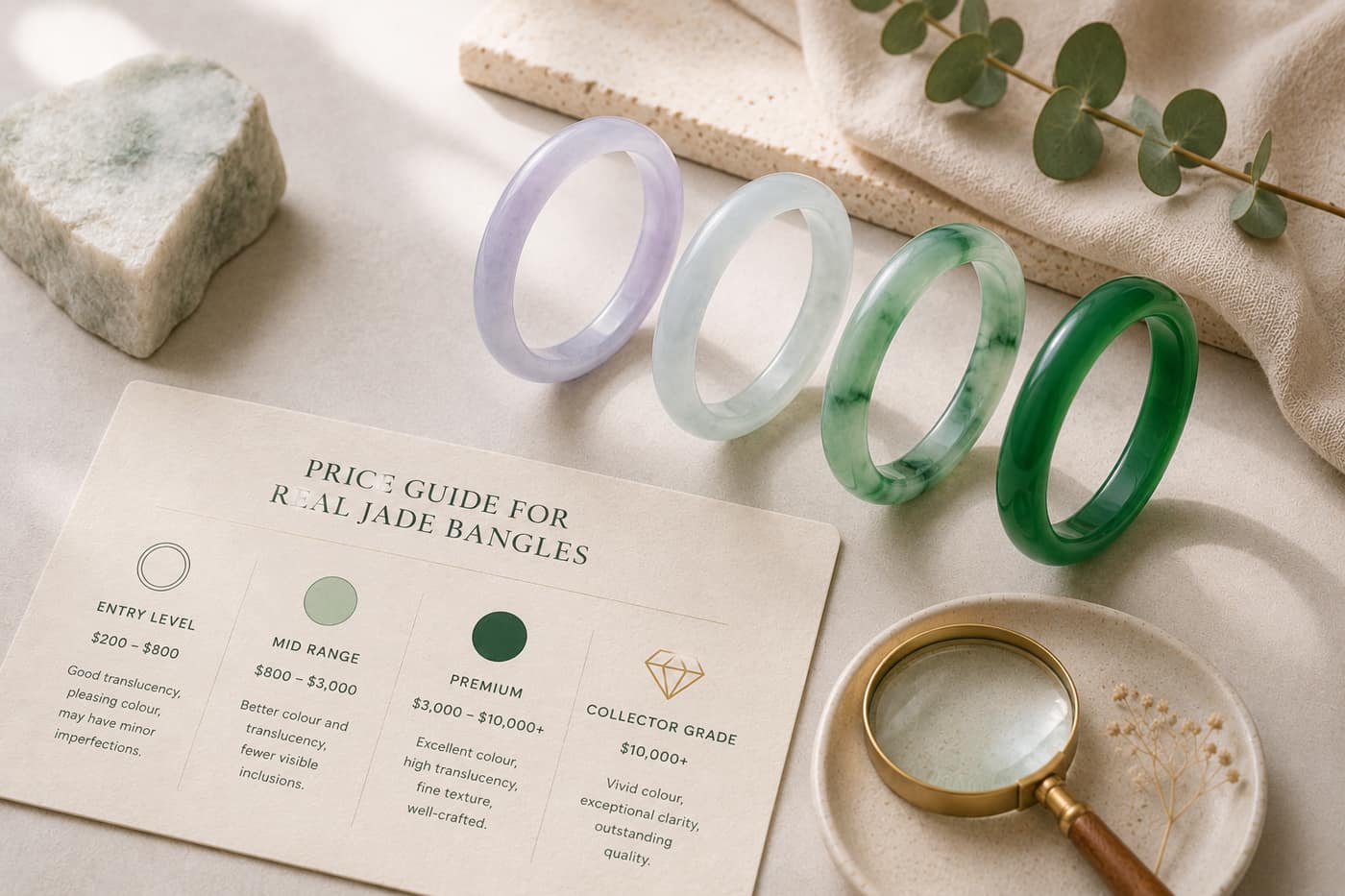
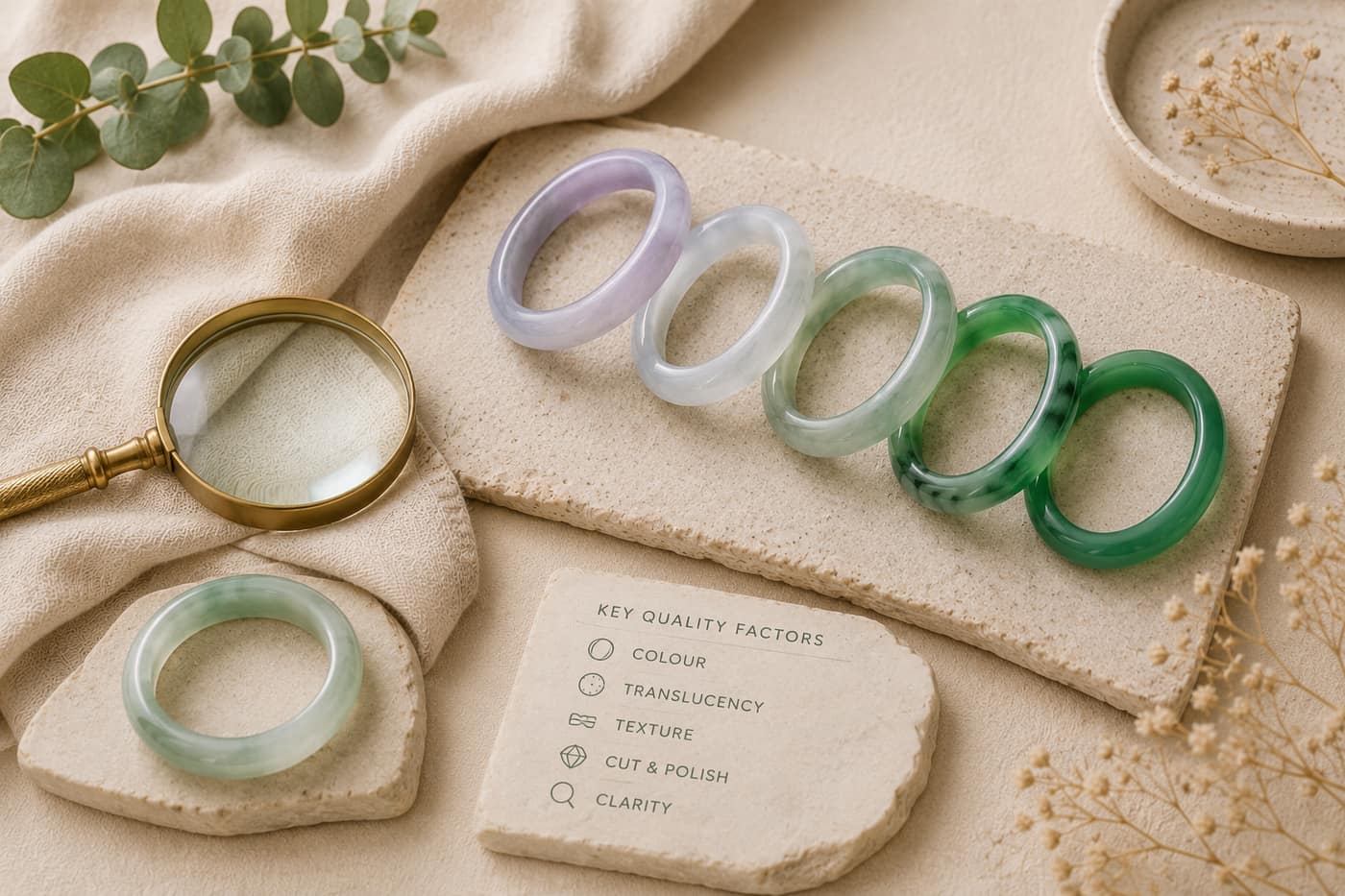
None of this outranks the stone itself. Colour, translucency, and texture still decide most of what a bangle is worth - shape sets the floor, the jade sets the ceiling. For the numbers behind that, see how much a real jade bangle should cost.
How does bangle shape change the fit?
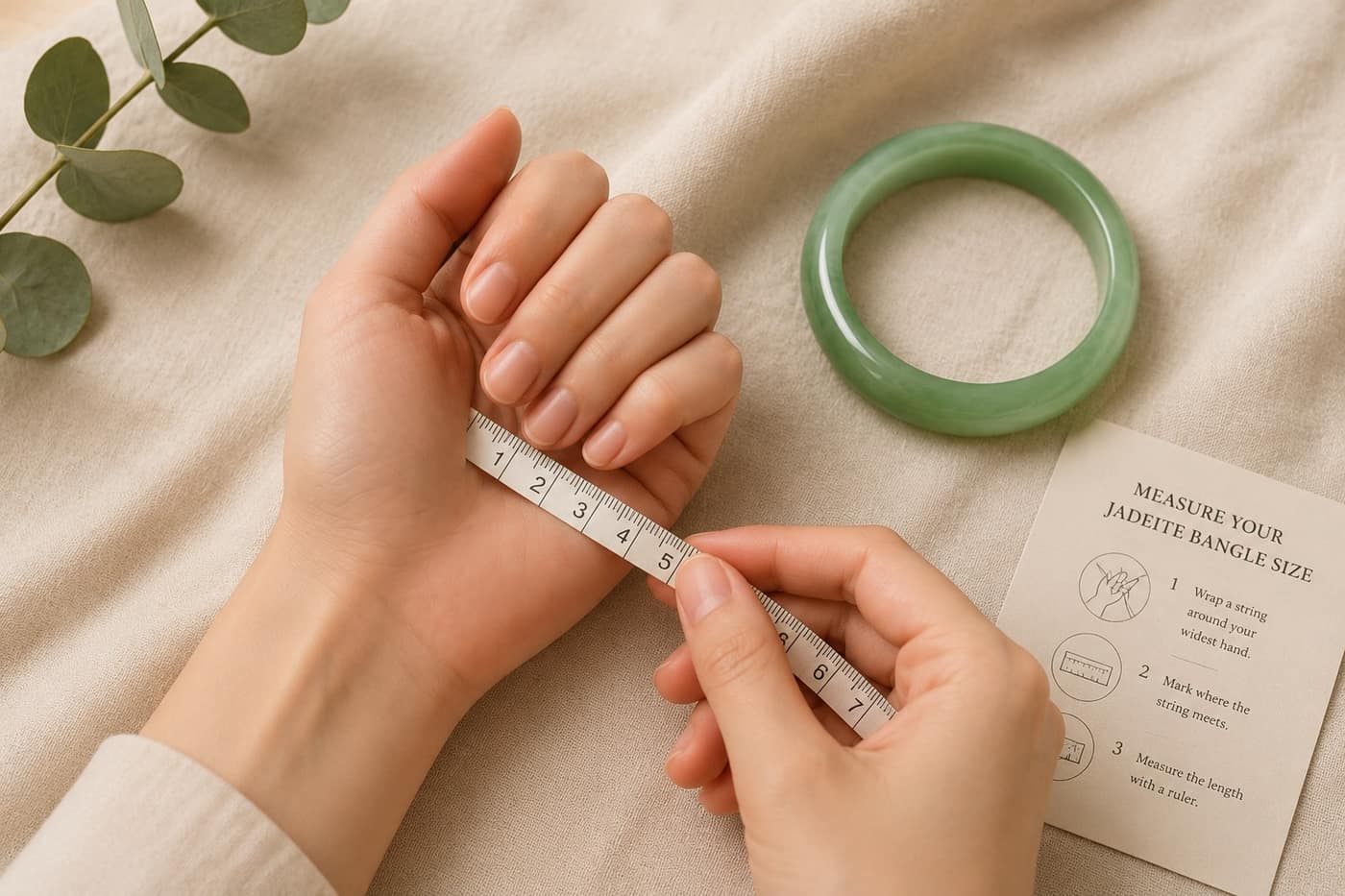
Jadeite cannot be opened, clasped, or resized, so shape and fit are the same conversation. Measure your hand first - the string method takes two minutes - then adjust for the shape you want.
- A round bar needs roughly 1-2 mm more inner diameter than a flat bar in the same size, because the thick bar eats into the opening as it crosses your knuckles.
- A concubine bangle is sized on its long axis. That is the measurement that must pass over your hand; the short axis is what holds it in place afterwards.
- Flat and square bars grip the wrist and stay put. Round bars rotate freely, which some people love and others find distracting at a keyboard.
- Slim bars are the most comfortable and the most fragile. Wide bars show the most stone and catch on desk edges the most.
- If you are between sizes, size up. A bangle that will not pass your hand is unwearable; one that is slightly loose is merely something to be careful with.
Which type of jade bangle should you choose?
There is no ranking here, only fit with your life. In practice:
- You want to wear it every day, at a desk, under sleeves: a concubine bangle or a cushioned car tire bangle.
- You want the traditional look, or it is a gift for an elder: a classic round bangle, or a plain round for something simpler.
- You want something light, or you want to stack two or three: a beauty bangle - and treat it gently.
- You have fallen for a particular stone: let the stone choose. Wide bands show floating colour best; the square bangle flatters even, translucent bodies; carving suits stone with more character than clarity.
What we tell you about shape
Every bangle at Jadeite Pavilion is natural, untreated Grade A jadeite, and every listing states the shape in plain words along with the inner diameter and the bar dimensions, so you are never guessing what "round" meant. Where a piece is carved, we say whether the carving is decorative or covers a natural mark, and where a stone carries cotton or a stone line, we photograph it rather than angle away from it.
If you would like to see a piece move in natural light before you decide, ask us for an inspection video. We would rather you chose the right shape once than the wrong shape twice.