The Four Things That Matter
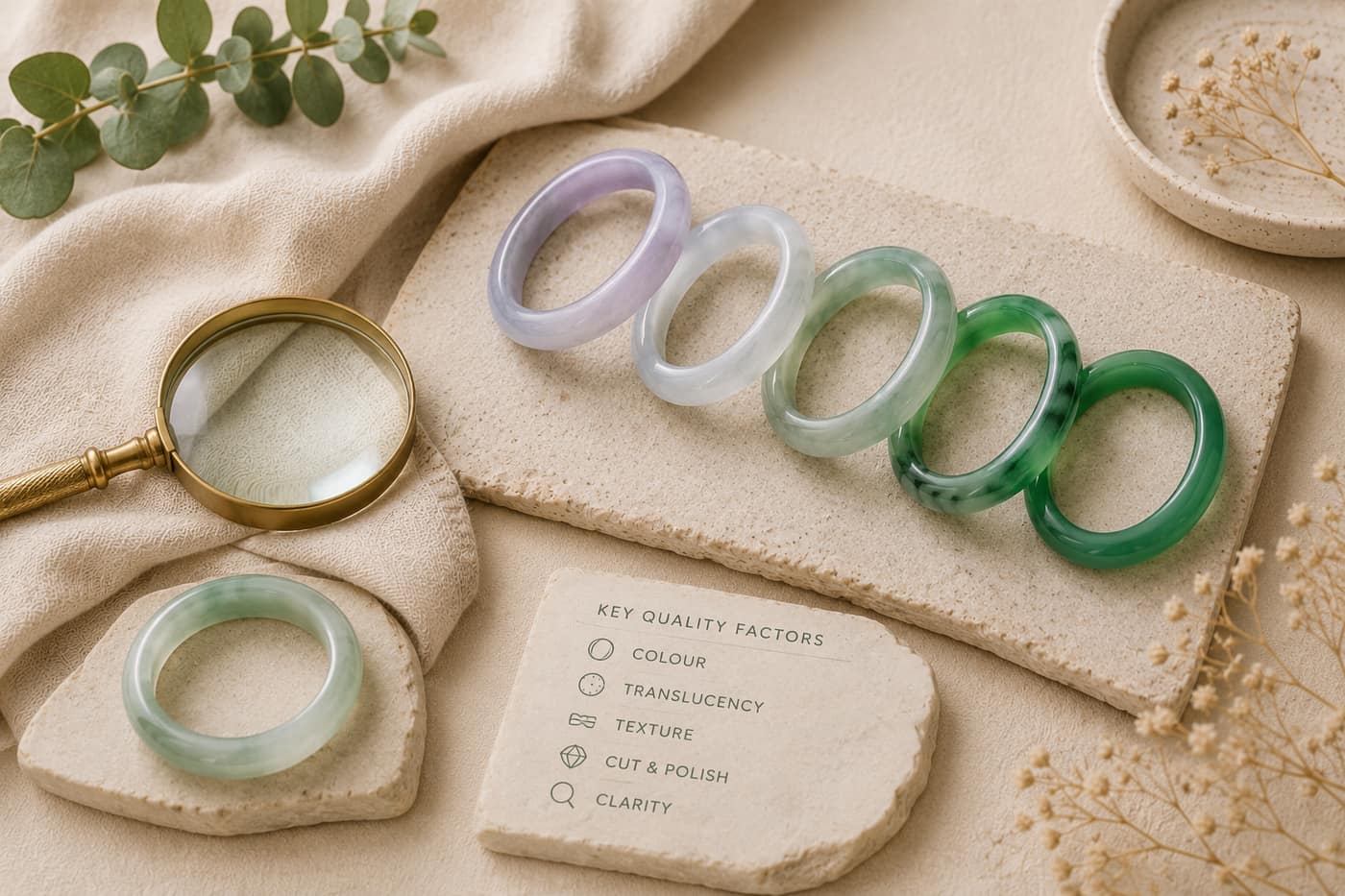
Jadeite quality comes down to four qualities working together: colour, translucency (often called "water"), texture, and craftsmanship. No single one tells the whole story. A vivid green that is completely opaque is worth far less than the same green with glassy translucency. Learning to read all four is how you judge a piece on its merits rather than its price tag.
1. Colour (色)
Three things determine how valuable a colour is:
- Saturation - how vivid and intense the colour is. Imperial green sits at the top; muted olive tones are more affordable.
- Evenness - colour spread evenly through the stone is worth more than patchy colour (though floating colour is valued precisely for being uneven).
- Tone - not too dark, not too pale. The colour should read clearly without looking black or washed out.
2. Translucency / Water (种水)
Translucency is how much light passes through the stone, and it is often the single biggest factor in a piece's character. Jadeite ranges from fully opaque, through semi-translucent and translucent, to highly translucent "glass species" (玻璃种) that looks like frozen water.
A stone with good "water" glows from within and makes colour come alive. This is why an icy white pendant with high translucency can be just as captivating as a green one. Every piece we list states its translucency level so you know what to expect.
3. Texture (底)
Texture refers to how fine the crystal grain is. The finer and tighter the grain, the smoother and more luminous the stone looks and feels. Coarser grain can give a slightly grainy or dry appearance. Under a loupe, fine crystallisation (结晶) is a hallmark of a well-formed natural stone.
4. Craftsmanship (工)
For carvings and cabochons, the cut and carving matter enormously. A skilled carver works with the stone - turning a patch of cotton into a cloud, or a colour vein into the spine of a leaf. Good proportions, symmetry, and polish all add to a piece's value and wearability.
Putting It Together
When you look at a piece, ask: how vivid and even is the colour, how much light passes through, how fine is the grain, and how well is it cut? A fair price is one where all four line up with what you are paying. Every Jadeite Pavilion listing gives you the colour, transparency, and honest condition so you can make that judgement yourself.