The short answer
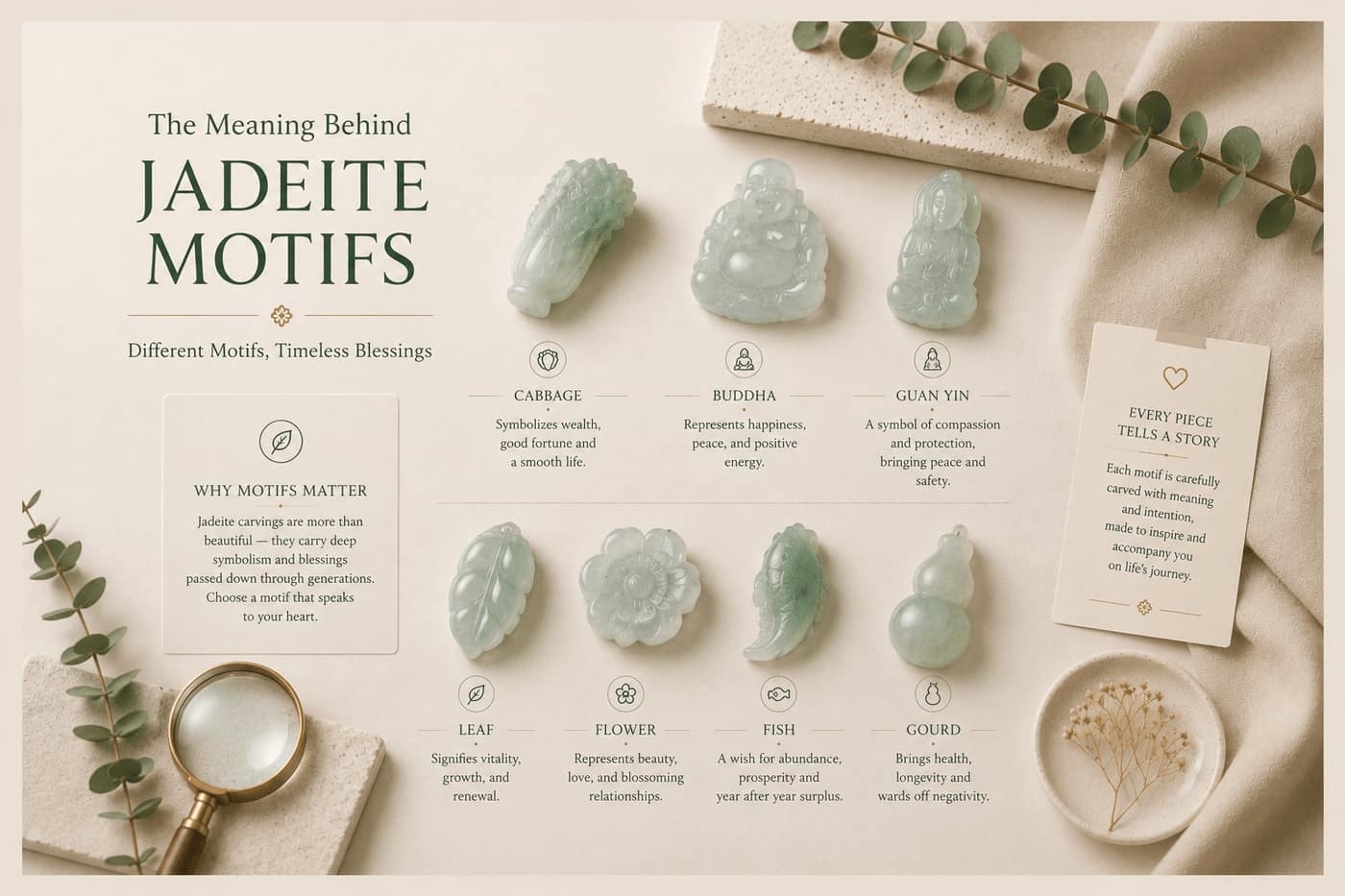
A jade pendant's meaning comes from the motif carved into it - a gourd, a cabbage, a fish, a figure of Guanyin - and almost every one of those meanings is a wish for the person who wears it. A gourd stands for good fortune, a cabbage for wealth, a plain plaque for a life without troubles, a peace buckle for safe passage.
These are traditional, cultural associations - ways of carrying a good wish close to you. They are not claims that a stone has any power of its own. Below is what the most-worn jadeite motifs represent, and, just as useful, how those meanings are made.
How a jade motif gets its meaning
Nearly all jade symbolism is built in one of two ways, and once you can see them you can almost read a new pendant on sight.
Homophones - the sound of the word. Chinese is rich in words that sound alike, so a carved object often stands for a luckier word it rhymes with. A fish (yu, 鱼) stands for surplus (yu, 余). A bat (fu, 蝠) stands for fortune (fu, 福). A gourd (hulu, 葫芦) stands for fortune and rank (fu lu, 福禄). The picture is a pun.
Imagery - the nature of the thing. Other meanings come from how the object behaves. Bamboo grows in rising segments, so it stands for steady progress and, being hollow yet straight, for integrity. A lotus rises clean out of the mud, so it stands for purity. The object is a small lesson.
The most-worn jadeite motifs, and what they mean
This is not every motif in existence, but it covers the pieces you are most likely to see and wear. Where a name is a pun, we have shown the words it plays on.
- Gourd葫芦 · hulu
- Sounds like fu lu (福禄), fortune and prosperity. Its joined chambers are read as family harmony and as gathering good things and keeping them. Often given to elders as a wish for health.
- Cabbage白菜 · baicai
- A wordplay on bai cai (百财), a hundred forms of wealth. The white stalk and green leaves also stand for purity and an honest character. A favourite for new homes and new businesses.
- Plain plaque无事牌 · wu shi pai
- A deliberately blank plaque. Wu shi (无事) means "no troubles". Because nothing is carved, the jade is shown with nothing hidden - a wish for a calm, peaceful, uneventful life, and a favourite of people who love a stone for itself.
- Peace buckle平安扣 · ping an kou
- A simple flat ring. Ping an (平安) means peace and safety, so it carries a wish for safe passage and freedom from harm. The unbroken circle is read as smoothness and continuity.
- Ruyi如意 · ruyi
- The name means "as you wish". The curved sceptre shape is a wish for things to go smoothly and for hopes to be fulfilled.
- Guanyin观音
- The figure of compassion and mercy. By tradition worn by men (nan dai Guanyin), associated with calm and steadiness. A wish to move through life gently and without anger.
- Buddha佛 · the laughing Buddha
- The content, open-hearted Buddha. By tradition worn by women (nü dai Fo), associated with contentment and tolerance - the ability to hold a broad, easy heart.
- Pixiu貔貅
- A mythical winged creature that, in tradition, takes in wealth and does not let it out. A popular motif for those wishing for gathered and kept prosperity. Cultural symbolism, not a claim of power.
- Bamboo竹 · zhu
- Grows in clear rising segments, jie jie gao (节节高) - steady progress, one stage after another. Hollow yet unbending, it also stands for integrity and a modest, upright character.
- Leaf叶 · ye
- From jin zhi yu ye (金枝玉叶), "golden branch, jade leaf", a phrase for nobility. A single fresh leaf is also read as a wish for a flourishing career and new beginnings.
- Fish鱼 · yu
- Sounds like yu (余), surplus, from nian nian you yu (年年有余) - abundance year after year. A wish for plenty that never runs out.
- Lotus莲 · lian
- Rises clean from the mud and stands for purity and integrity. Lian (莲) also sounds like lian (连), continuous, so a lotus carries a wish for things - love, harmony, good fortune - that continue unbroken.
- Butterfly蝴蝶 · hudie
- A symbol of love and joy, and of a free, light spirit. Die (蝶) echoes the sound in a phrase for long life, so it also carries a quiet wish for longevity.
- Coin铜钱 · tong qian
- The old round coin with a square hole stands plainly for wealth. Its round-outside, square-inside form is also read as a balanced character: flexible with the world, principled within.
Guanyin or Buddha - who wears which
The two most-worn jade figures are Guanyin, the bodhisattva of compassion, and the laughing Buddha. There is an old saying about them: nan dai Guanyin, nü dai Fo (男戴观音,女戴佛) - men wear Guanyin, women wear Buddha.
The idea is one of balance. Guanyin's calm and mercy were thought to steady a man's temper; the Buddha's broad, content heart was thought to ease a woman's worries. It is a custom, not a rule, and today many people simply choose the figure whose spirit they feel closest to.
Does the meaning change the value?
Not on its own. What a piece is worth is decided by the jade - its colour, its translucency, its size, and the quality of the carving - not by which motif it happens to be. Two gourds of the same size can be worlds apart in price because one has richer, more even colour.
What the motif does change is the fit: whether a piece feels like it was meant for you or for the person you are giving it to. A cabbage for someone starting a business, a peace buckle for someone travelling, a leaf for a new chapter - the meaning is what turns a beautiful stone into a personal one.
Choosing a piece by its meaning
Every carved piece at Jadeite Pavilion is natural, untreated Grade A jadeite, photographed exactly as it is and guaranteed for life. When you are choosing, let the meaning narrow the field and let the stone make the final decision - the colour you cannot stop looking at is usually the right one.
If you would like help finding a particular motif, or a piece for a specific wish or occasion, tell us what you have in mind and we will show you what is in the gallery.