Why is this so affordable - is it real?
It is a fair question, and most people are too polite to ask it out loud. So let us answer it plainly: yes, the piece is real, natural, untreated Grade A jadeite. And the reason it is affordable is the opposite of what you might fear.
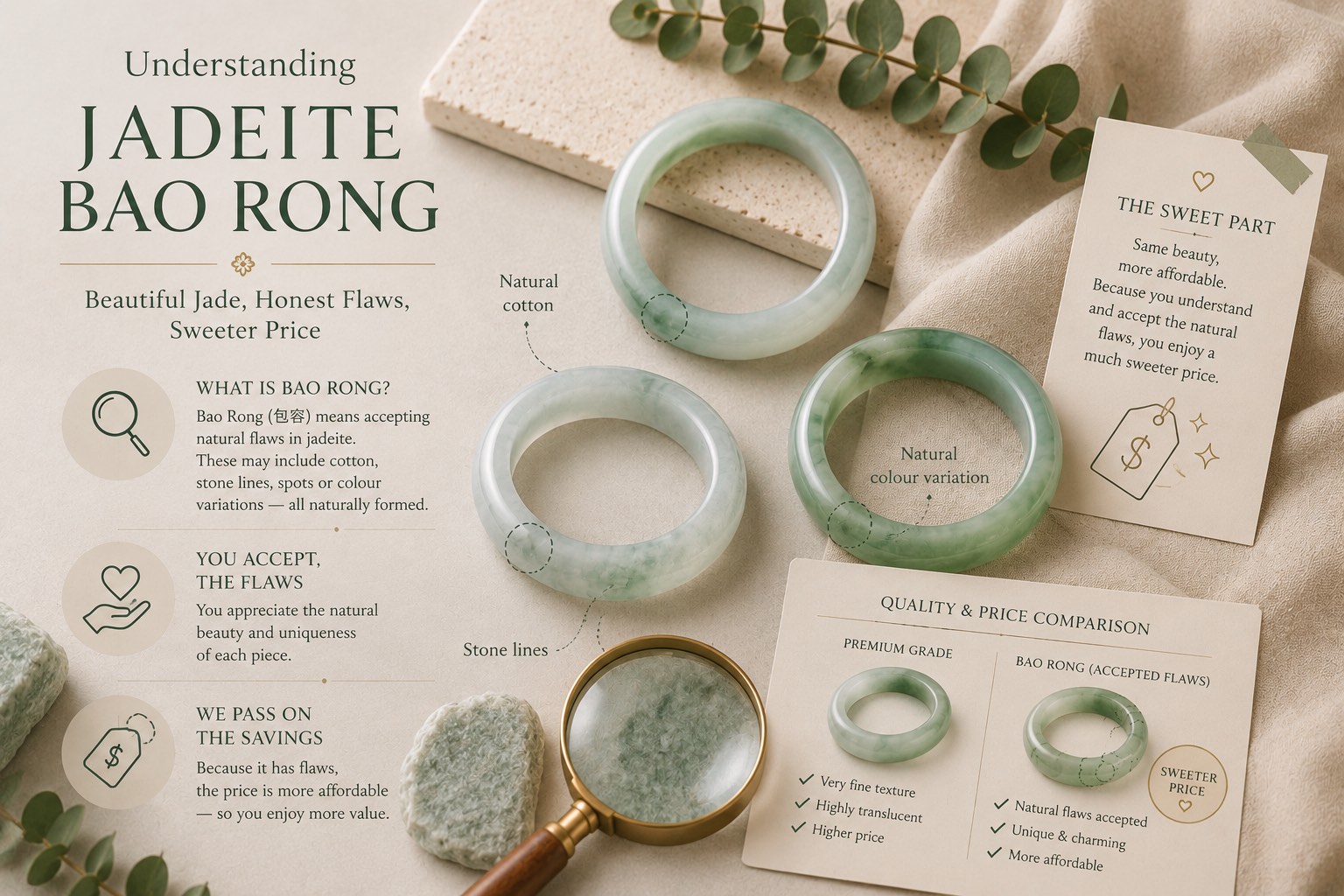
Look closely at a natural stone and you will see a faint wisp of cloudiness, a soft line drifting through it, colour that pools a little deeper on one side than the other. Those are not damage, and they are not the signs of a fake. They are the reason you can hold this piece at this price. The Chinese have a single word for them: 包容.
What 包容 actually asks you to accept
Before you decide how you feel about a stone's natural marks, you deserve to know exactly what they are. There are only three, and none of them is a flaw in the way that word usually means. This is the whole list - nothing is hidden.
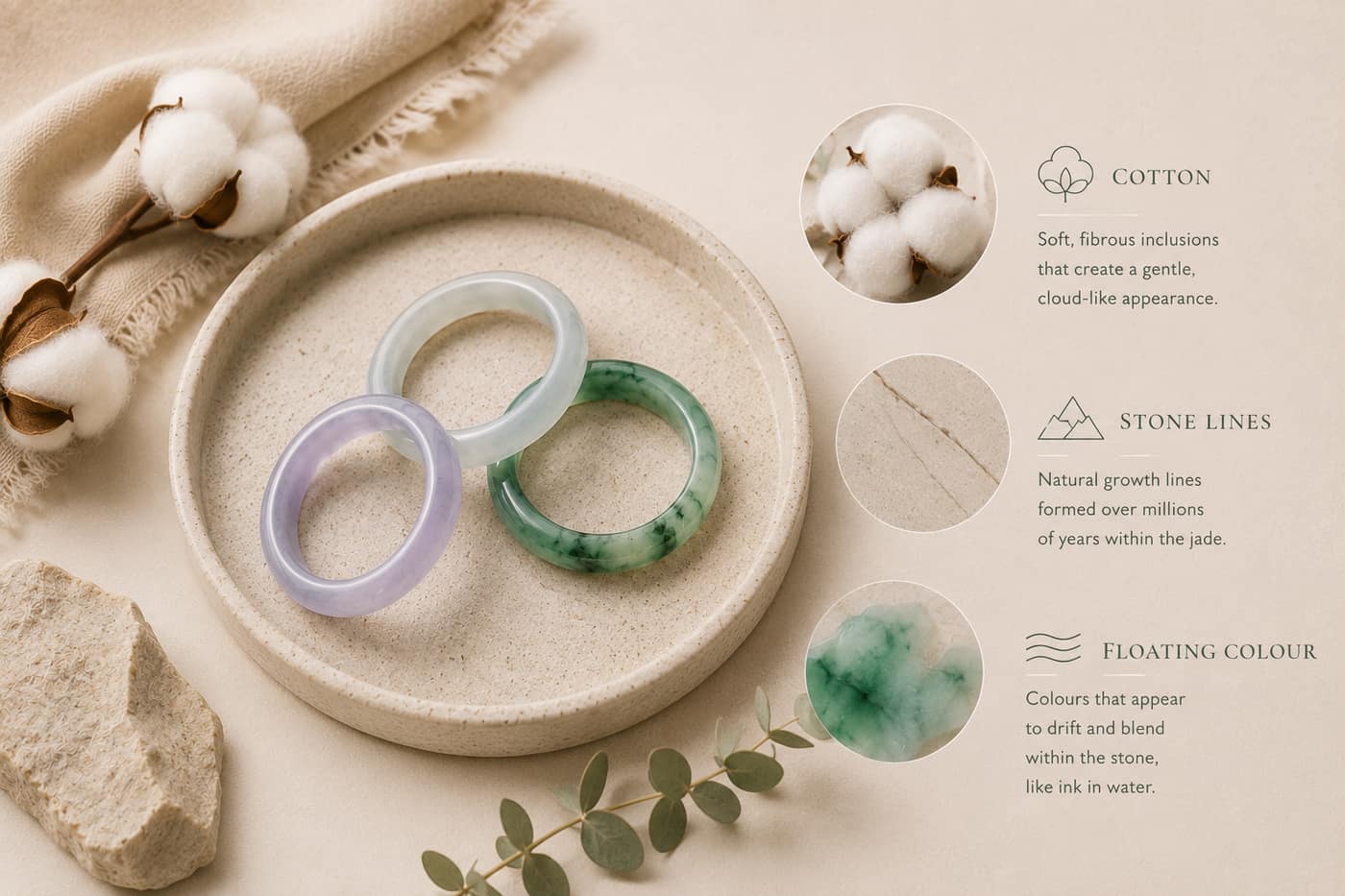
- Cotton (棉) - soft, white, cloud-like wisps inside the stone, formed as the jade slowly crystallised over millions of years. It is not dirt and not a mark on the surface. In a translucent piece it gives the stone depth and movement, like mist held in glass.
- Stone lines (石纹) - fine, healed veins running through the crystal, like the grain in a piece of solid wood. This is the one most people worry about, so let us be clear: a stone line is not a crack. It is smooth, it is structurally sound, and it will not catch your fingernail. (An open crack is a different thing, and an honest seller discloses it separately.)
- Colour variation - colour that is richer in one area and softer in another, rather than flat and identical all over. Real jade almost never grows perfectly even. The only reliable way to make colour uniform is to dye it.
That is the whole of it. When we ask whether you can accept a stone's 包容, this is what we mean: a little cotton, a faint line, a colour that lives and shifts. Once you can name them, they stop being unsettling. We describe and photograph all three on every product page, and you can read more in our guide to cotton, stone lines and floating colour.
Why these marks make it cost less
Here is the part that makes everything click. Jade is priced by rarity, and the single rarest thing in all of jade is perfection - a stone that is vividly coloured, evenly coloured, and glass-clear all at once. Nature produces that combination very seldom, which is why those few stones sell for the price of a car, or a house.
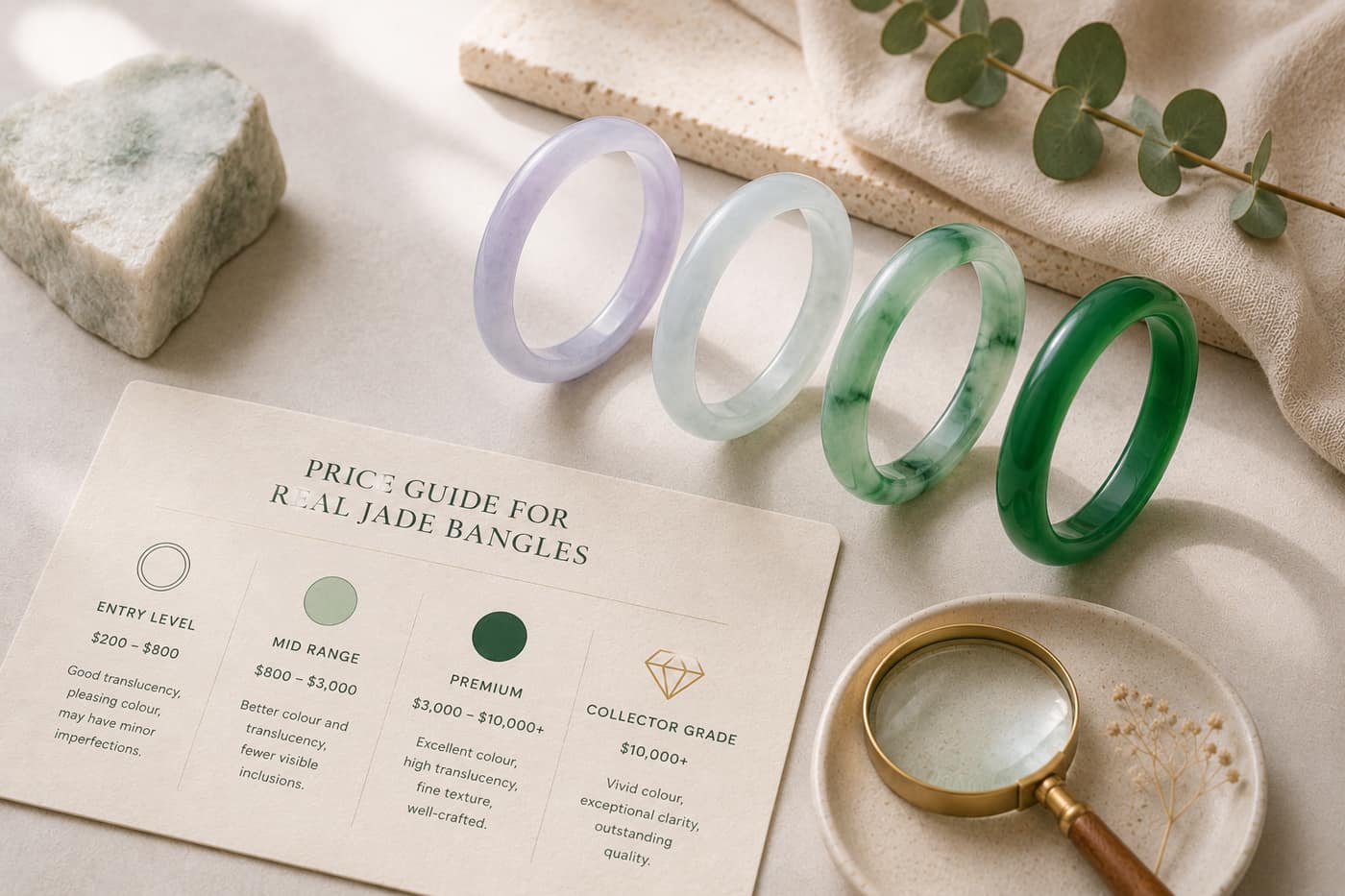
A stone with a little cotton, a soft line, and a gentle, uneven colour is far more common - and so it is far more affordable. Not because it is less real, and not because it has been treated, but simply because nature makes more of it. You are paying less for one reason only: rarity, not authenticity. The genuineness is identical. For a fuller picture of what moves a price from under fifty dollars to six figures, see our guide to what a real jade bangle should cost.
The stone to fear is the perfect one
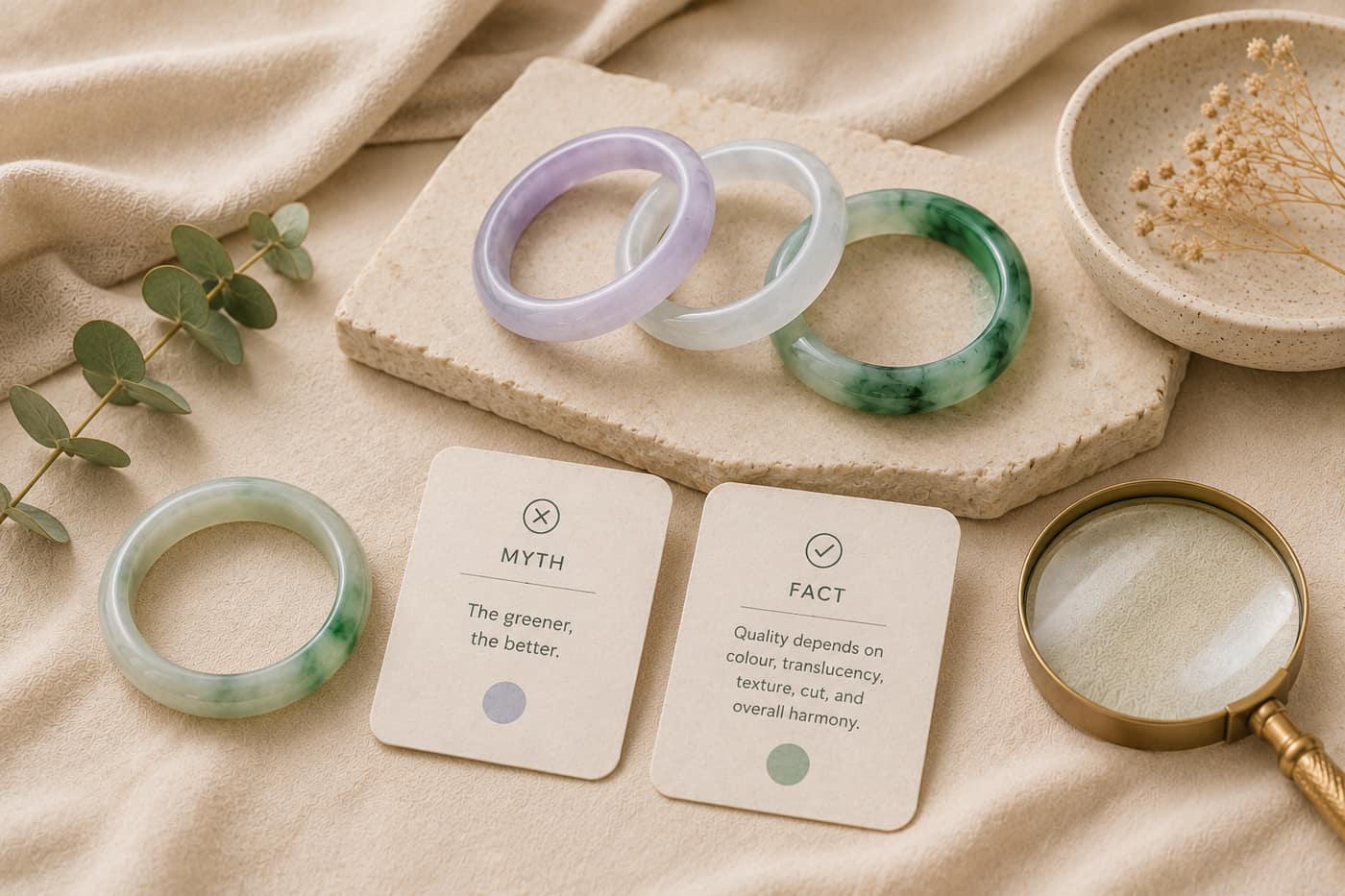
Now turn the instinct around. If a piece is flawless, vividly green, glass-clear, and somehow cheap, that is the stone to walk away from. Nature does not grow that stone and sell it for pocket money. When you see those four things together at a low price, it almost always means the stone has been bleached, filled with polymer, or dyed to look that way - Grade B or Grade C jade that will dull, yellow, and crack within a few years.
So the small natural marks are doing something valuable for you beyond saving money: they are your proof. They are the evidence that no factory has touched the stone, because faking imperfection is something no one bothers to do. Perfection is the disguise. 包容 is the fingerprint of the real thing.
And the mark is the part that is only yours
There is one more thing worth saying, because it is the part people quietly fall for. A flawless, mass-made bead looks exactly like every other flawless bead in the tray. The particular drift of cotton in your stone, the exact path of its single soft line, the way its colour deepens just there - that pattern exists on one piece of jade on earth, and now it is yours. The very thing you were told to read as a flaw is the thing that makes the piece unrepeatable.
包容: to contain, and to embrace
包容 carries two meanings at once, and both are the point. It means to contain - this stone holds its cotton and its lines openly, with nothing bleached away or hidden. And it means to embrace, to accept a thing as it is without needing it to be perfect. It is one of the most admired qualities a person can have, and it is exactly what a natural stone asks of you.
Choosing a piece like this is a small act of 包容. You accept a wisp of cotton you can barely see, and in return you receive jade that is genuinely real, certifiably Grade A, entirely your own, and actually within reach. You do not have to pretend the mark is not there. You only have to decide it does not bother you - and once you understand what it is, proof rather than damage, most people find that it does not.
That is the most honest, and most affordable, way into real jade there is. Every piece at Jadeite Pavilion is natural, untreated Grade A, photographed exactly as it is, 包容 and all, and guaranteed for life.