What Is Burnt Colour Jadeite?
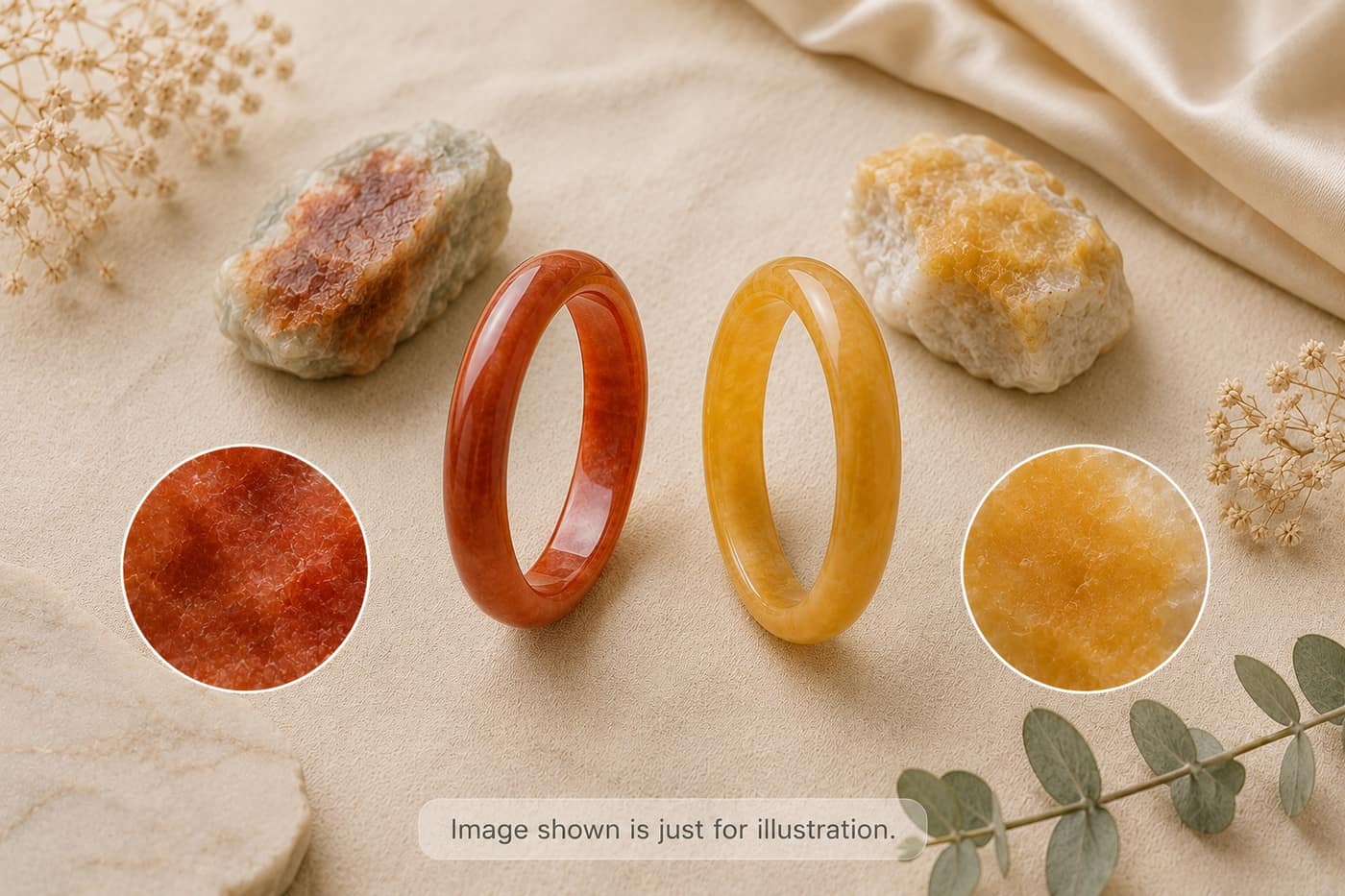
"Burnt colour" (翡) refers to jadeite that displays red, orange, or yellow tones. These warm colours come from iron oxide (essentially natural rust) that seeped into the stone over millions of years while it lay in iron-rich soil or riverbeds.
The term "burnt" is a translation of the Chinese concept, not a description of artificial heating. Natural burnt colour jadeite is formed entirely by geological processes and is 100% certifiable as Grade A.
Red Jadeite (红翡 Hong Fei)
Red jadeite gets its colour from a higher concentration of iron oxide. The red typically appears as a "skin" or outer layer on jadeite boulders, because the iron seeps inward from the surface over time.
The finest red jadeite has a warm, rich tone, sometimes described as cinnabar red or roasted chestnut. When combined with good translucency, red jadeite is genuinely rare. Most red jadeite on the market is opaque, which keeps prices accessible.
In Chinese culture, red symbolises good fortune, celebration, and vitality. Red jadeite pendants and carvings are popular gifts for weddings, birthdays, and Lunar New Year.
Yellow Jadeite (黄翡 Huang Fei)
Yellow jadeite forms through the same iron oxidation process but at a lower concentration than red. The result is a warm golden to amber tone. Fine yellow jadeite can be surprisingly translucent, glowing like honey when light passes through.
The most prized yellow is sometimes called "chicken-oil yellow" (鸡油黄), a rich, saturated golden tone that is even and consistent through the stone. This is quite rare and commands strong collector interest.
Yellow represents wealth, prosperity, and imperial authority in Chinese tradition. Historically, yellow was reserved for the emperor, making yellow jadeite carry special cultural significance.
Can Burnt Colour Jadeite Be Certified Grade A?
Yes, absolutely. Grade A certification is about treatment, not colour. As long as the stone has not been bleached (B), dyed (C), or polymer-filled, it qualifies as Grade A regardless of colour.
Natural iron oxidation is a geological process, not a treatment. Reputable gemological laboratories can distinguish between natural oxidation and artificial manipulation through spectroscopic analysis. The key indicators they look for:
- Colour gradient: natural oxidation creates gradual, uneven transitions from the outer surface inward. The colour is not uniform throughout.
- Surface texture: natural burnt colour integrates smoothly with the stone's grain structure. Artificial colouring sits on top or in cracks.
- Internal structure: under magnification, natural burnt colour follows the stone's crystal boundaries. Dye pools in fractures and grain gaps.
Natural vs Heat-Treated: How to Tell
Some sellers heat-treat jadeite to intensify or create red and yellow tones. While heating does mimic the natural oxidation process (it accelerates what nature does slowly), it is considered a treatment and the resulting stone should not be sold as Grade A.
Here is what to watch for:
- Natural: colour transitions are gradual and follow the stone's contours. The surface has no heat-induced micro-cracks. Translucency is consistent.
- Heat-treated: colour may be unusually uniform or vivid. Tiny hairline cracks from thermal stress may be visible under magnification. The stone may feel slightly drier.
- Dyed: colour concentrates along cracks and grain boundaries. Under a Chelsea filter or UV light, dyed areas may fluoresce differently. The giveaway is colour pooling in surface fractures.
The safest approach is to buy from a seller who provides lab certification, or who will refund if the piece fails independent testing. At Jadeite Pavilion, every piece comes with a lifetime Grade A guarantee.
Collecting Burnt Colour Jadeite
Red and yellow jadeite represent excellent value for collectors. They are genuinely natural, certifiably Grade A, culturally meaningful, and far more affordable than green of equivalent quality. A fine red or yellow pendant can cost a fraction of what a comparable green piece would command.
Look for pieces with good translucency, rich saturation, and smooth colour transitions. These three qualities together indicate a high-quality natural stone. And always ask to see it under a torch light, where the warmth and depth of natural iron colour truly come alive.